


I’ll be honest — I used to buy everything on Amazon. Groceries, electronics, dog toys, and yes, supplements. Prime shipping is addictive. But after a sketchy experience with a bottle of vitamin D3 that smelled like paint thinner and had a suspiciously peeled safety seal, I started asking a question I probably should’ve asked years earlier: is Amazon actually the best place to buy supplements?
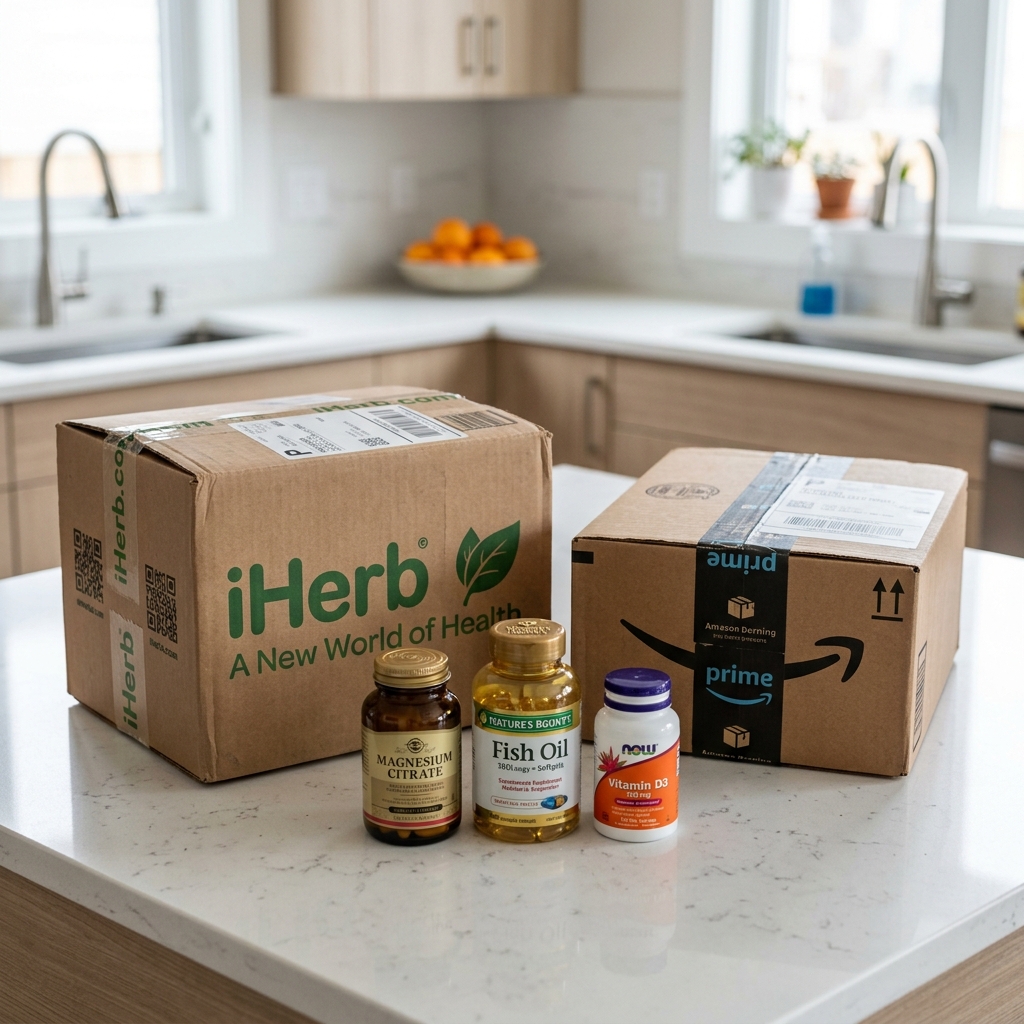
That question led me down a rabbit hole, and eventually to iHerb — a platform I’d heard about but never really explored. After spending the last two years buying from both platforms (and meticulously comparing receipts, shipping times, and product quality), I’ve got a lot of thoughts. So let’s break this down category by category.
The Price Battle: Who Actually Charges Less?
This is what everyone wants to know first, so let’s get into it. I tracked prices on a handful of popular supplements across both platforms over several months. Prices fluctuate, but the patterns are pretty consistent.
Real Price Comparisons (Checked Mid-2026)
| Product | iHerb Price | Amazon Price | Notes |
|---|---|---|---|
| NOW Foods Magnesium Citrate, 200mg, 250 tablets | ~$11.50 | ~$11.00–$14.99 | Amazon price varies wildly by seller |
| Garden of Life Dr. Formulated Probiotics, 50 Billion, 30 caps | ~$33.59 | ~$29.99–$38.00 | Amazon’s lowest is often a third-party seller |
| California Gold Nutrition Omega-3 Fish Oil, 240 softgels | ~$13.00 | ~$16.50+ | iHerb house brand, cheaper at source |
| Sports Research Vitamin D3+K2, 60 softgels | ~$13.56 | ~$13.56–$15.99 | Often identical; Amazon Subscribe & Save can edge lower |
| Doctor’s Best High Absorption CoQ10, 100mg, 120 softgels | ~$18.90 | ~$17.49–$22.00 | Amazon’s best price usually requires Subscribe & Save |
Here’s what I noticed: Amazon’s lowest price sometimes beats iHerb, but that lowest price often comes from a third-party seller you’ve never heard of. When you compare Amazon’s “Sold by Amazon” price or the brand’s official Amazon storefront, iHerb is frequently cheaper or within a dollar.
Where iHerb really pulls ahead is with its own house brands — California Gold Nutrition, Lake Avenue Nutrition, and others. These are solid, well-tested products that are significantly cheaper than comparable options on Amazon because there’s no middleman markup. Also, iHerb regularly runs loyalty credits and combo deals that shave another 5–10% off if you know where to look.
Authenticity and Counterfeit Risks: The Elephant in the Room
Let me be blunt: this is where the comparison gets uncomfortable for Amazon.
Amazon’s marketplace model means that multiple sellers — including random third parties — can list the same product. Worse, Amazon uses a system called “commingled inventory” where products from different sellers get mixed together in the same warehouse bin. So even if you buy from the “official” brand listing, the actual bottle you receive might have been sourced from a completely different seller.
There have been well-documented cases of counterfeit supplements showing up on Amazon. From fake protein powders to adulterated herbal extracts, it’s a real problem. The FDA has issued warnings. Brands themselves have spoken out about unauthorized sellers on Amazon peddling expired or tampered products.
How iHerb Handles Sourcing Differently
iHerb operates on a fundamentally different model. They buy directly from manufacturers and brands — no third-party sellers, no marketplace free-for-all. Every product in their warehouse was sourced through an authorized channel. They also run their own climate-controlled fulfillment centers, which matters a lot for probiotics and fish oils that degrade in heat.
Is it theoretically possible to get a bad product from iHerb? Sure, nothing’s perfect. But the structural risk is dramatically lower. You’re not gambling on which random seller’s inventory you’ll receive. You know where it came from.
For me personally, this was the tipping point. Once I understood how Amazon’s commingled inventory worked, buying premium supplements there started to feel like a coin flip I didn’t need to take.
Shipping Speed and International Reach
If you live in the U.S. and have Prime, Amazon wins on speed. Period. Next-day or same-day delivery is tough to beat for sheer convenience.
iHerb typically ships within 1–2 business days from their California warehouse, and domestic orders usually arrive in 3–5 days. Not blazing fast, but perfectly reasonable. Where iHerb genuinely shines is international shipping. They ship to over 185 countries with localized pricing, duties/taxes calculated at checkout, and surprisingly affordable shipping rates. If you’re outside the U.S., iHerb is often the better — and sometimes the only practical — option for getting authentic supplements at fair prices.
Amazon’s international supplement shipping is hit-or-miss. Many supplement listings are restricted from international shipping, and when they are available, the added costs can be brutal.
Product Selection: Breadth vs. Depth
Amazon has more stuff — no question. You can find virtually any supplement brand on Amazon, including tiny indie brands, random imported products, and discontinued items from resellers.
But more isn’t always better. iHerb carries over 30,000 products from around 1,800 brands, which covers all the major players: NOW Foods, Solgar, Nature’s Way, Garden of Life, Life Extension, Thorne (select products), Doctor’s Best, and many more. They’ve also expanded heavily into K-beauty, natural foods, and personal care — so it’s not just supplements anymore.
The difference is curation. iHerb vets the brands they carry. Amazon lets anyone sell anything (within their broad guidelines). If you want a specific niche product from a micro-brand, Amazon might have it. But for mainstream, quality-tested supplements? iHerb’s catalog is more than deep enough.
Customer Reviews: Helpful or Hopeless?
Amazon’s Review Problem
Amazon’s review ecosystem is… compromised. There’s a whole industry of fake reviews, incentivized reviews, and review manipulation. Fakespot and ReviewMeta exist for a reason. I’ve seen supplement listings with thousands of five-star reviews that read like they were written by the same person (or, let’s be real, the same bot). Vine reviews help, but they’re a drop in the ocean.
iHerb’s Review System
iHerb requires a verified purchase to leave a review, and they don’t run an equivalent of Amazon’s Vine program. The reviews tend to be shorter and more genuine — regular people sharing whether a product worked for them. Are there still some questionable reviews? Probably. But the overall signal-to-noise ratio is noticeably better. I actually trust a 4.2-star rating on iHerb in a way I don’t on Amazon.
Return Policies and Customer Service
Amazon’s return policy is famously generous — you can return almost anything within 30 days, often with free return shipping. For supplements, this is a solid safety net, especially if you receive a damaged or suspicious product.
iHerb offers a 60-day return window on most products, which is actually longer than Amazon’s. However, the process is a bit more involved — you typically need to contact their support team, and return shipping may not always be free depending on the reason. For damaged or defective items, they’re generally responsive and will issue refunds or credits without too much hassle.
Neither platform is perfect here, but both are reasonable. I’d call this one roughly a draw, with Amazon having a slight edge on the ease of returns and iHerb winning on the length of the return window.
The Full Comparison at a Glance
| Category | iHerb | Amazon | Winner |
|---|---|---|---|
| Pricing | Competitive; house brands are a steal | Can be lower via Subscribe & Save | 🤝 Tie |
| Authenticity | Direct from brands; no third-party sellers | Commingled inventory; counterfeit risks | ✅ iHerb |
| Shipping (U.S.) | 3–5 days standard | 1–2 days with Prime | ✅ Amazon |
| Shipping (International) | 185+ countries; affordable rates | Limited; often restricted or pricey | ✅ iHerb |
| Product Selection | 30,000+ curated products | Virtually unlimited listings | ✅ Amazon |
| Review Trustworthiness | Verified purchase only; more authentic | Volume is high but manipulation is rampant | ✅ iHerb |
| Return Policy | 60-day window | 30-day window; easier process | 🤝 Tie |
| Storage & Handling | Climate-controlled warehouses | Standard fulfillment; varies | ✅ iHerb |
When Amazon Still Makes Sense
Look, I’m not here to tell you to never buy supplements on Amazon. There are situations where it’s the right call:
- You need something today (or tomorrow). Prime speed is unmatched. If you ran out of your daily multivitamin and need it ASAP, Amazon delivers — literally.
- You’re buying from the brand’s own Amazon storefront. Some brands like Sports Research and Nature Made run their own Amazon stores with inventory they control. This significantly reduces the counterfeit risk.
- Subscribe & Save pricing is genuinely better. For a few products, the Subscribe & Save discount on Amazon creates a price gap that’s hard to ignore — especially if you stack it with coupon clips.
- You want a very niche or discontinued product. Amazon’s long tail of third-party sellers means you can sometimes find products that are out of stock everywhere else.
When iHerb Is the Smarter Choice
For most supplement buyers — especially those who care about what they’re putting in their bodies — iHerb comes out ahead in the areas that matter most:
- You want guaranteed authenticity. No third-party seller roulette. No commingled inventory. Every product sourced directly from the brand.
- You buy temperature-sensitive supplements. Probiotics, fish oils, certain vitamins — these degrade in heat. iHerb’s climate-controlled storage matters more than most people realize.
- You live outside the U.S. iHerb’s international infrastructure is years ahead of Amazon’s when it comes to supplements.
- You prefer curated quality over endless choice. Sometimes having fewer options — but better-vetted ones — is a feature, not a limitation.
- You want honest reviews from real buyers. iHerb’s review system isn’t perfect, but it’s dramatically less corrupted than Amazon’s.
My Bottom Line
After two years of buying from both platforms, here’s where I’ve landed: I buy about 80% of my supplements on iHerb and 20% on Amazon. The 80% on iHerb covers my regular stack — magnesium, fish oil, probiotics, vitamin D, and a few specialty items. The peace of mind knowing I’m getting authentic products, stored properly, at competitive prices is worth the extra day or two of shipping.
The 20% on Amazon? That’s for the odd product iHerb doesn’t carry, or the occasional emergency restock where I need something by tomorrow morning.
If you haven’t tried iHerb yet, it’s worth at least putting together a test order and comparing. Move one or two of your regular products over and see how the experience compares. I think you’ll notice the difference — not just in price, but in the overall quality of the experience. And honestly? In the confidence you feel opening that bottle.