



I remember a time, not so long ago, when my agency’s content workflow was less a streamlined process and more a chaotic, multi-headed hydra. As the lead content strategist for a small but ambitious digital marketing firm specializing in tech startups, I was constantly drowning under a deluge of diverse content demands. One moment, I’d be meticulously researching the intricacies of a new blockchain protocol for a client’s in-depth whitepaper, then immediately pivot to crafting snappy, engaging social media updates for a different client’s B2B SaaS launch. Before I could even catch my breath, I’d be tasked with developing a compelling email sequence for a product launch, followed by drafting internal documentation for our own evolving processes. It felt like I was perpetually context-switching, wearing a dozen different hats, each demanding a full day’s worth of focused attention. The mental overhead was immense, and the quality, while never truly suffering thanks to sheer willpower and late nights, was definitely inconsistent in its initial stages.
My attempts to tame this beast were numerous and, frankly, exhausting. We subscribed to a veritable smorgasbord of AI writing tools – one touted for long-form content generation, another specifically for social media captions, and yet another for optimizing email subject lines. My workflow often involved generating ideas in ChatGPT, copying the output into Claude for refinement and tone adjustment, then pasting that into our project management software for team review. It was a fragmented, copy-paste-heavy process that felt incredibly inefficient and prone to errors. We even brought on a part-time virtual assistant to handle some of the initial content research and basic formatting, but even that felt like adding another layer of management and communication rather than truly solving the core problem of scaling our content generation capabilities without sacrificing quality or burning out the team. The combined cost of these multiple AI subscriptions, coupled with the VA’s hours, was steadily eroding our profit margins. The breaking point arrived with the acquisition of a major new client, a Series A funded startup with an aggressive product launch schedule. They needed an entire suite of marketing collateral – ten comprehensive blog posts, four distinct email sequences, fifty unique social media posts, a detailed FAQ section, and an in-depth competitor analysis – all compressed into a tight six-week deadline. To compound the challenge, our lead technical writer went on an unexpected medical leave, leaving me to also oversee critical updates to our internal API documentation for another existing client. I was staring down the barrel of an unavoidable 80-hour work week, fueled by caffeine and a growing sense of panic, acutely aware that our current setup simply couldn’t handle the sheer volume and complexity without severely compromising the quality of our output or, more likely, my personal sanity.
It was during a particularly frantic Tuesday afternoon, with a blank document mocking me from my screen as I struggled to conjure a compelling narrative for a client’s new cybersecurity feature, that a glimmer of hope appeared. My colleague, Mark, usually quite reserved about his tech discoveries, mentioned offhand that he’d been exploring something from Stardock, a company I knew more for desktop utilities and games, that was marketing “AI Staff for Everyone.” He vaguely described it as being fundamentally different from your typical chatbot experience. Intrigued, and frankly desperate, I immediately Googled “Stardock AI staff” and quickly landed on the Clairvoyance website. My initial impression was a complex mix of skepticism and cautious optimism. The claims on the page sounded almost too good to be true: “a team of named, persistent AI agents that work together to build apps, create documents, and analyze data. Not another chatbot.” The promise of local execution, meaning my sensitive client data would remain securely on my machine, was an immediate and significant draw. The idea of “multiple agents, real output, works while you sleep” resonated deeply with my current predicament. The website offered a free download, with the reassuring claim of “30 seconds to install. No Docker. No YAML.” That was the decisive moment. I was so utterly frustrated with my existing, inefficient toolkit and so desperate for a solution that wasn’t just another browser tab or a glorified text editor that I clicked “Download Free” without a moment’s hesitation. I needed something, anything, to alleviate the crushing pressure, and the low barrier to entry for this Clairvoyance review felt like a sign I couldn’t ignore.
The installation process for Clairvoyance was, to my genuine astonishment, precisely as advertised. I downloaded the desktop application, ran the installer, and within a matter of minutes, I was prompted to connect my existing AI provider API keys. I opted to integrate my Claude and OpenAI keys first, as those were the models I relied upon most frequently. The user interface itself was remarkably clean, professional, and felt like a proper, robust desktop application, a refreshing change from the often clunky or overly simplistic web UIs I had grown accustomed to. It immediately conveyed a sense of seriousness and utility, less like a toy and more like a powerful professional tool. My very first real task for my newly acquired “AI staff” involved a dual challenge that perfectly mirrored my daily struggles. For the new cybersecurity client, I needed an initial draft of an email sequence designed to introduce their innovative new feature to existing customers, with a clear focus on articulating benefits and driving a specific call to action. Simultaneously, for the internal API documentation project, I wanted a concise summary of recent changes to a specific module, based on a provided changelog and several code snippets. I created two distinct “agents” within Clairvoyance, consciously naming one “Sally” (envisioning her as my marketing/sales content specialist) and the other “Marcus” (my dedicated technical documentation expert). I provided Sally with the detailed prompt for the email sequence, including the target audience, key selling points, and the desired tone. In parallel, I fed Marcus the changelog and code snippets, instructing him to generate a concise summary of the functional impacts of the recent API modifications.
My honest reaction to the initial output was one of profound, almost stunned, efficiency. While Sally was diligently drafting the first few emails of the sequence, Marcus was already actively processing the complex technical information. The desktop UI visually displayed their progress, almost like watching two virtual assistants typing away simultaneously on their respective tasks. Within approximately 20 minutes, I had a surprisingly good first draft of a 3-email sequence from Sally, complete with relevant subject line suggestions and some compelling body copy. It wasn’t perfect, naturally requiring some adjustments to align with the client’s precise brand voice and to strengthen a few hooks, but it was easily 80% there – a monumental leap forward from the agonizing process of staring at a blank page. Marcus, on the other hand, delivered a clear, well-structured, bullet-pointed summary of the API changes, accurately highlighting potential breaking changes and newly introduced functionalities. It was remarkably accurate, requiring only minimal technical correction from my end. The specific detail that truly surprised and impressed me was the “persistent memory” aspect. When I gave Sally a follow-up instruction to refine one of the email drafts, she remembered the previous context of our conversation and applied the changes intelligently, rather than starting from scratch like a typical stateless chatbot. This was a massive differentiator from my previous copy-paste workflow, where every interaction with an AI tool felt like a fresh, disconnected start. It genuinely felt like having assistants who actually remembered what they were working on and built upon previous instructions.
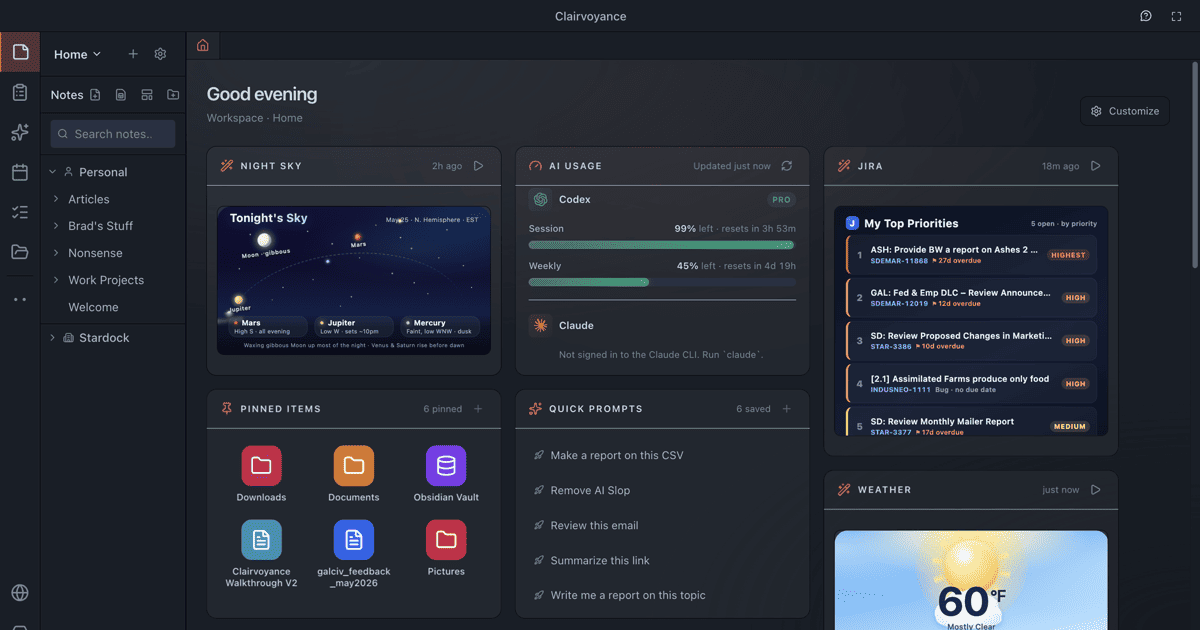
Now, Clairvoyance has undeniably transitioned from a desperate last resort into an absolutely indispensable part of my daily and weekly workflow. It has fundamentally transformed how I approach content generation and strategic planning for our agency. I’ve since expanded my “AI staff” to include a few more specialized agents, each with a distinct role. “Quinn” has become my dedicated market research analyst, constantly sifting through industry news, competitor reports, and client feedback to provide daily briefings or ad-hoc summaries on emerging trends. “Marcus” continues to be my reliable go-to for all things technical documentation, internal reports, and even drafting initial project proposals that demand a structured, data-driven approach. “Sally” remains my primary content creator for all marketing copy, churning out initial drafts for blog posts, social media campaigns, and email sequences with remarkable speed. I’ve even experimented with a “Leo” for legal-adjacent content, helping me draft disclaimers or privacy policy summaries based on provided legal texts (always, of course, with the explicit understanding that these drafts are for internal review and must be thoroughly vetted by actual legal counsel before any external use).
What Clairvoyance does exceptionally well is orchestrating complex, multi-stage tasks that, in the past, would have required me to manually switch between several different tools and painstakingly maintain context myself. For instance, when we initiate a new client’s content strategy, I can seamlessly assign Quinn to conduct a comprehensive competitive content audit and identify critical content gaps, while Sally simultaneously drafts outline structures for a series of blog posts based on our initial SEO keyword research. The incredible ability for these agents to work in parallel, each operating within their own persistent, specialized contexts, means I can set a series of interconnected tasks and return to a suite of coherent, actionable outputs. This saves me an immense amount of time on the initial, often arduous, heavy lifting. I can confidently say it cuts down my content research and initial drafting time for a comprehensive campaign by at least 60%, and sometimes even more. What used to consume a full day of arduous context-switching, rudimentary drafting across disparate platforms, and constant mental gymnastics is now condensed into a focused hour or two of intelligent prompting and refinement within Clairvoyance. This newfound efficiency allows me to dedicate significantly more of my valuable time to strategic thinking, nuanced client communication, and the final, crucial polish that truly elevates our agency’s output and distinguishes us in the market.
However, it would be disingenuous to present Clairvoyance as a perfect, all-encompassing solution. It’s not a silver bullet, and I’m keenly aware of its limitations. While the platform excels at generating structured content and summarizing vast amounts of information, it still struggles with truly unique, highly creative, or deeply empathetic writing. For example, crafting a brand’s core narrative that aims to evoke specific, complex emotions or developing a groundbreaking headline that truly captures an audience’s imagination often requires a level of human intuition and a nuanced understanding of cultural context that even advanced AI agents simply don’t possess yet. I’ve consistently found that for those “aha!” moments, those flashes of genuine creative brilliance, I still need to step in and infuse the crucial human touch. Occasionally, an agent might get stuck in a repetitive loop, generating similar variations without truly progressing the task, or misinterpret a subtle nuance in a complex prompt, leading to an output that, while technically correct in its composition, is entirely off-brand or misses the intended strategic mark. These instances necessitate pausing the agent, carefully refining the prompt, and sometimes even restarting the task, which can be a minor but nonetheless frustrating annoyance when you’re working against a tight deadline. Compared to my old process, where I was painstakingly drafting every single word myself or micro-managing a freelancer for initial content, the quality difference for initial drafts and research is profound. The time saved is immense, easily justifying the investment. But for that final 10-20% of creative magic, strategic insight, or profound empathy, my human brain is still very much in charge, providing the essential direction and refinement.
One aspect that, despite my overall satisfaction, occasionally grates on me is the resource intensity. When I have multiple agents actively running complex tasks in parallel, especially those involving extensive data processing or intricate code generation, my machine’s CPU and RAM usage can spike quite noticeably. It’s not a constant issue, but when I’m simultaneously trying to run a high-definition video conference or render a complex design file, it can sometimes lead to a bit of system lag. It’s an understandable trade-off for the benefit of local execution and enhanced data security, of course, but it’s something I’ve had to adapt to by consciously scheduling heavier tasks during off-peak hours or when I’m away from my desk. Another minor frustration is the occasional, albeit infrequent, inconsistency in output quality from the same agent on similar tasks. While generally reliable, there are days when an agent might produce a perfectly structured, insightful, and comprehensive report, and other days when it feels like it’s merely scratching the surface, requiring more extensive manual editing and additional, more granular prompting from my end. It serves as a consistent reminder that even with persistent memory and advanced capabilities, AI still operates on probabilities and patterns, not genuine understanding or consistent creative spark.
Despite these minor quibbles, the pricing structure for Clairvoyance feels entirely justified for the immense value and capabilities I receive. When I meticulously consider the cumulative cost of the multiple specialized AI subscriptions I’ve been able to cancel, the hundreds of hours I’ve saved (which directly translate into increased billable client work or a significant reduction in personal overtime), and the demonstrably increased capacity of our small team, the initial investment has paid for itself many times over. It’s not merely about saving money; it’s fundamentally about unlocking our agency’s capacity, significantly reducing stress, and empowering us to confidently take on more ambitious and complex projects without the immediate necessity of expanding our headcount. However, there are still specific situations where I find myself reverting to my old, more manual ways, at least partially. For instance, when a client absolutely requires a highly sensitive, emotionally resonant piece of content – perhaps a public apology statement or a deeply personal brand story that needs to connect on a profound human level – I still unequivocally prefer to craft the initial draft myself, relying on my own empathy, intuition, and nuanced understanding of human psychology. While Clairvoyance can certainly assist with the structure and overall tone, the authentic heart and soul of such a message need to originate from a human. Similarly, for highly specialized technical content that demands absolute precision, industry-specific jargon, and zero ambiguity, I’ll often leverage the agents for initial research, data synthesis, and rough outlines, but the final, authoritative version still demands the meticulous review and input of a human subject matter expert, sometimes even necessitating a return to manual drafting to ensure every single technical detail is perfectly aligned with the client’s exacting specifications and industry standards.
I’m incredibly keen to dive much deeper into the “recruit sub-staff” feature, as I haven’t yet fully leveraged its potential for breaking down truly massive, multi-faceted projects into smaller, parallel tasks for an even more distributed and efficient AI workflow. I’m also actively planning to integrate our agency’s rapidly growing internal knowledge base more thoroughly into Clairvoyance’s workspaces, hoping to further train my AI staff to become even more expert and context-aware in our specific niche and client requirements. It’s an ongoing process of refinement and exploration, but one that has already fundamentally shifted how I approach content generation, strategic planning, and overall productivity within our agency.